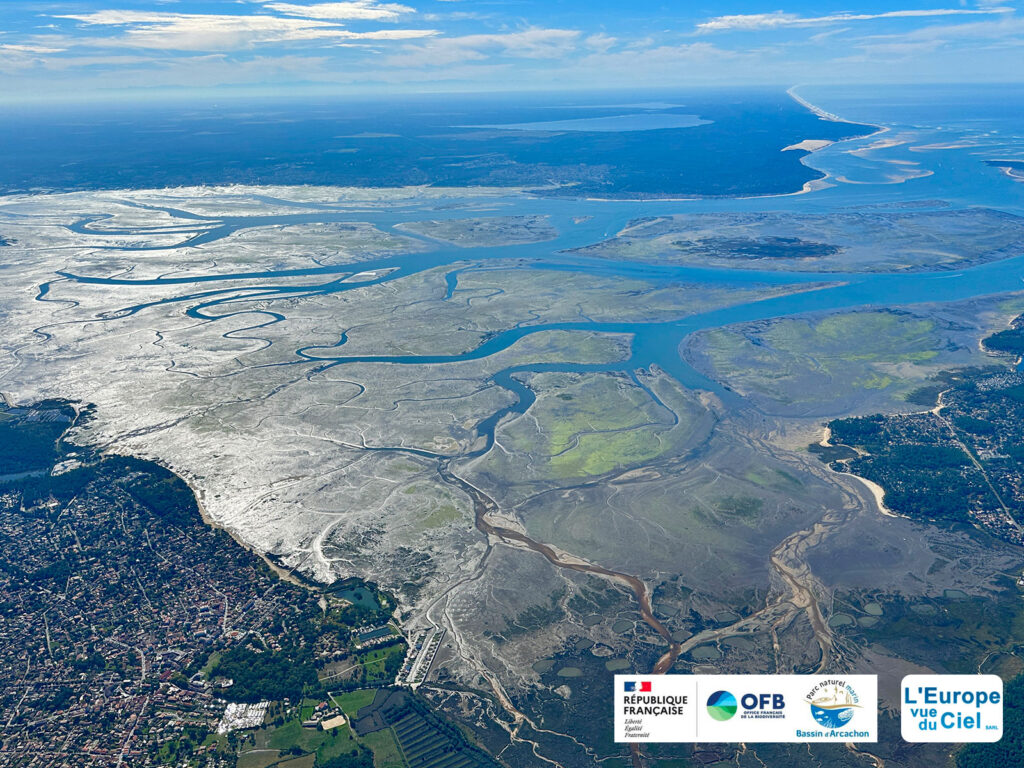
Planning for community-led marine habitat restoration.
From October 2026 until September 2027 The Ocean Gardeners will work in collaboration with Oxford Seascape Ecology Lab and le Parc naturel marin du Bassin d’Arcachon to lay the foundations for community-led and science-based seascape restoration in Bassin d’Arcachon.
Supporting local momentum, we will collaborate with our partners to establish the scientific, spatial, and social evidence base needed to transition and scale up from single-habitat restoration to multi-habitat seascape restoration ahead of the Plan de gestion 2032-2047.
Our Objectives
The Bassin d’Arcachon Seascape Project is centred on four core outputs:
(1) advancing community participation in restoration,
(2) conducting a geospatial synthesis and gap assessment;
(3) undertaking participatory mapping to identify restoration opportunities, cultural seascape values, and socio-ecological priorities;
(4) co-developing a Theory of Change and shared restoration vision through stakeholder and community engagement, including arts-based communication tools.
Powered by partnerships
This project builds on long-standing partnerships between the
Parc naturel marin du Bassin d’Arcachon, The Ocean Gardeners,
the Oxford Seascape Ecology Lab, the Rijksuniversiteit Groningen and a number of local restoration practitioners. The outcomes will strengthen local knowledge, partnerships, and community engagement and create a direct pathway for implementing long-term seascape restoration within this ecologically and socially vibrant seascape.
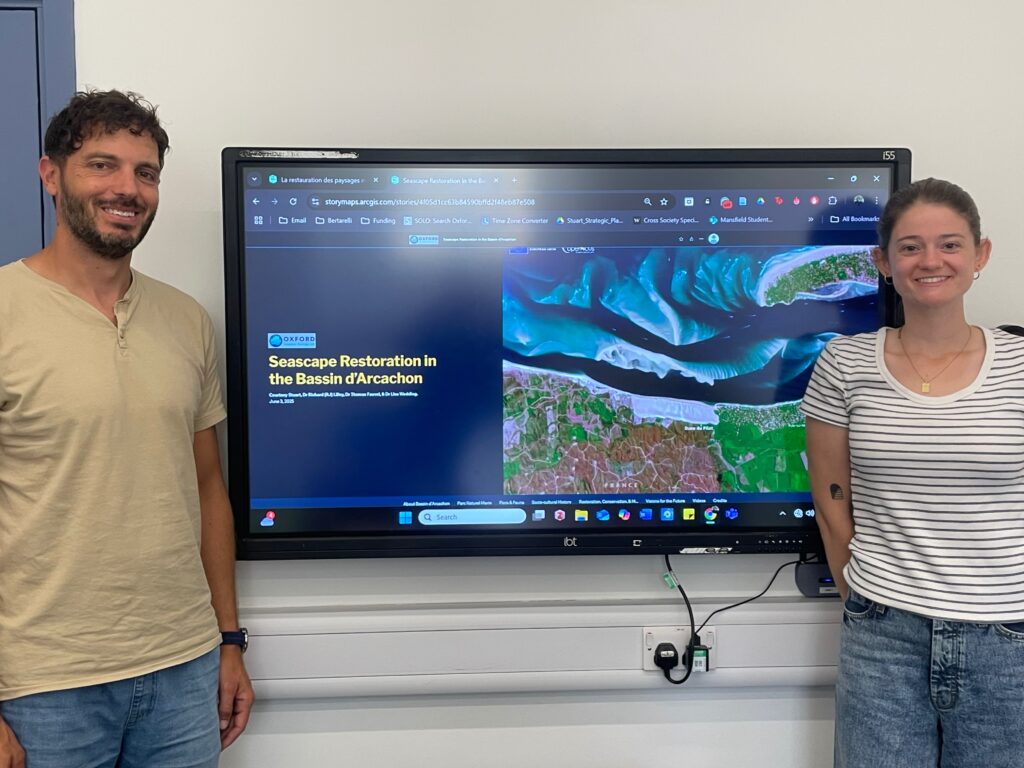
In partnership with
Oxford Seascape Ecology Lab
The Oxford Seascape Ecology Lab focuses on understanding the social-ecological causes and consequences of spatial patterns and processes in the sea, with the aim of developing science-based solutions to support marine management and policy.
In collaboration with
Le Parc naturel marin du Bassin d’Arcachon
The Arcachon Bay Marine Natural Park is a French marine protected area created by decree on 5 June 2014 to implement concerted management in the protection of the marine environment. It is supported by local governance, the ‘Le conseil de gestion’ (Management Board), made up of local stakeholders. It is supported by agents and resources allocated by the L’Office français de la biodiversité (French Office for Biodiversity).
Ifremer Station d’Arcachon
The Institut Français de Recherche pour l’Exploitation de la Mer (Ifremer) conducts research, innovates, and provides expertise to protect the ocean, sustainably manage its resources, and share marine data.
Rijksuniversiteit Groningen
The Conservation Ecology Group aims to contribute both to fundamental insights in structure and functioning of communities and ecosystems on both ecological and evolutionary time scales, and to provide insights that help in conserving the biodiversity of our planet and the sustainable management of ecosystems.
Supported by
Endangered Landscapes & Seascapes Programme
The Bassin d’Arcachon Seascape Project is supported by the Endangered Landscapes & Seascapes Programme (ELSP), managed by the Cambridge Conservation Initiative and funded by Arcadia.
Patagonia
Patagonia supports environmental organizations with bold, direct-action agendas and a commitment to long-term change.